

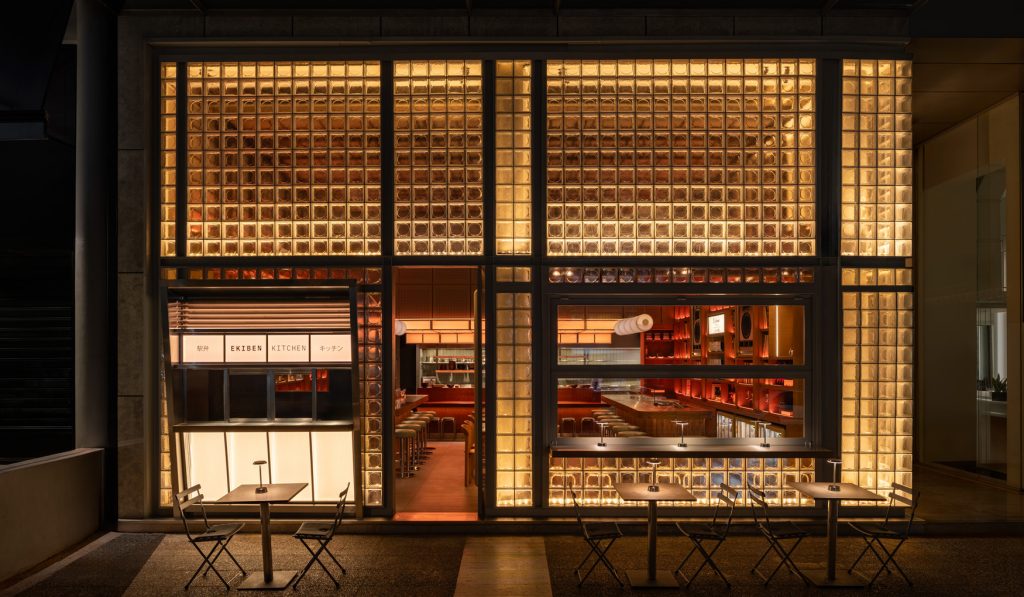
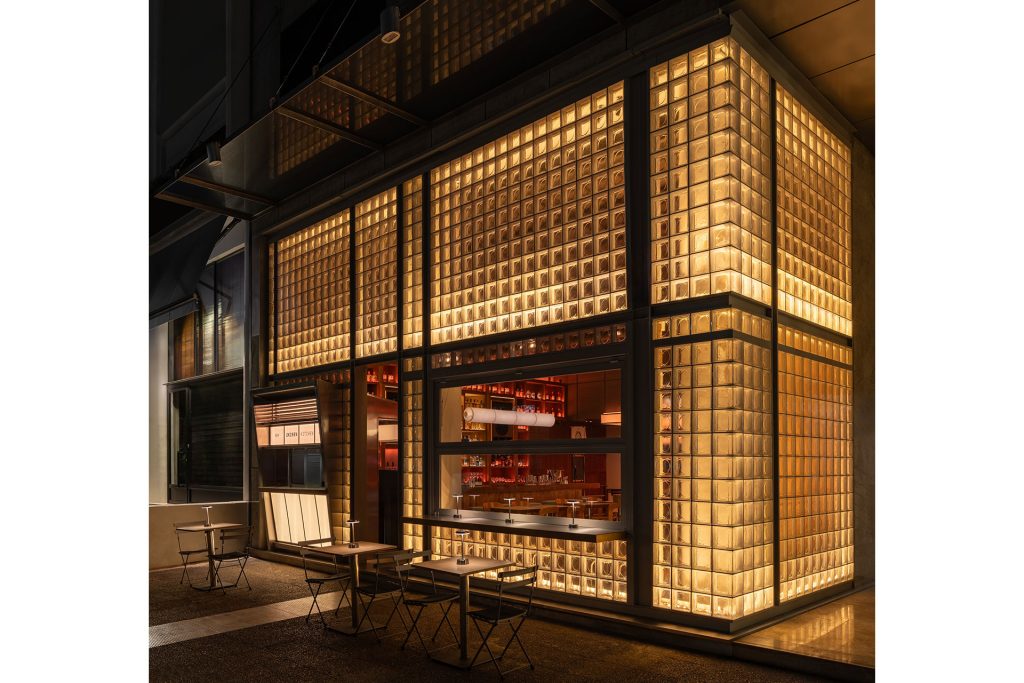
There is a moment, just after dusk, when a building stops being a building and becomes something closer to a promise. On a corner in Glyfada, the Athenian Riviera neighbourhood that has always had one eye on Tokyo without quite knowing it, Ekiben South has become exactly that: a glowing amber volume suspended between the architecture of two cultures, serving dinner to one and paying quiet tribute to the other.
The project comes from Flux Office, the Athens-based practice led by Thanassis Demiris, Eva Manidaki, Betty Tsaousi and Ilektra Naoum, a team whose portfolio moves fluidly between restaurant architecture, theatrical scenography and exhibition design. That cross-disciplinary fluency is entirely evident here. Ekiben South does not feel like a restaurant that has been decorated. It feels like a space that has been scored, composed with the same care a director gives to staging.
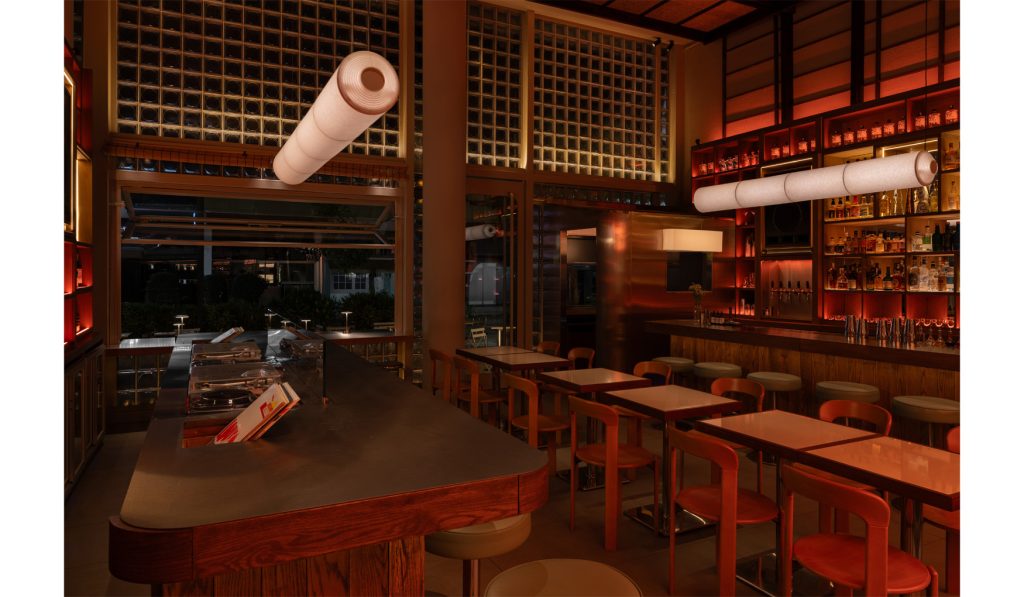
The defining architectural move is the glass-brick facade, semi-translucent, structural, deeply Japanese in spirit. In daylight it diffuses the Greek sun into something milky and contemplative, casting the interior in a light that feels borrowed from Kyoto rather than the Aegean. The texture of the bricks reads almost geological from the street, stacked and unhurried, while the interior life behind them flickers as suggestion rather than spectacle.
“By night the relationship inverts. The illuminated interior turns the glass bricks into a luminous body, an urban lantern that pulses with the warmth of the kitchen and the hum of conversation inside.”
It is this day-to-night inversion that elevates the project from good restaurant design to something genuinely memorable. The facade does not merely shelter the space. It performs. Warm amber and deep red tones push outward through the glass as evening arrives, making the building legible from a distance as something worth seeking out. A landmark, in the oldest and most literal sense.
Embedded seamlessly into the glass-brick volume is a take-away window, conceived as a shop-in-shop micro-pavilion. Framed by the building’s signature signage, it functions as the threshold between the street and the full Ekiben experience: a point of contact that draws passersby in without asking them to commit.
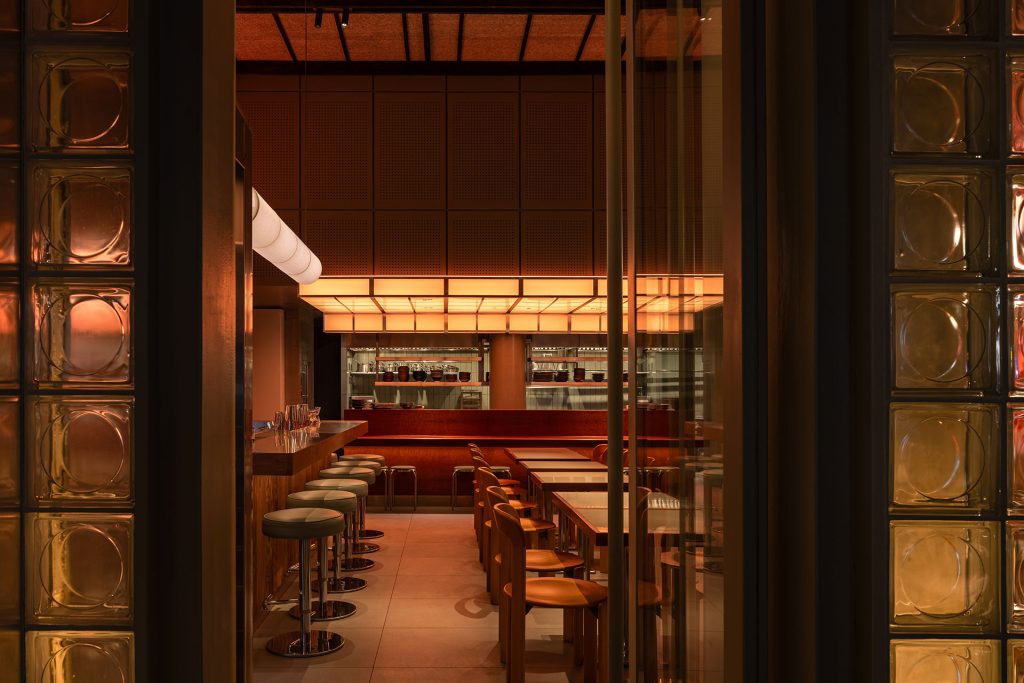
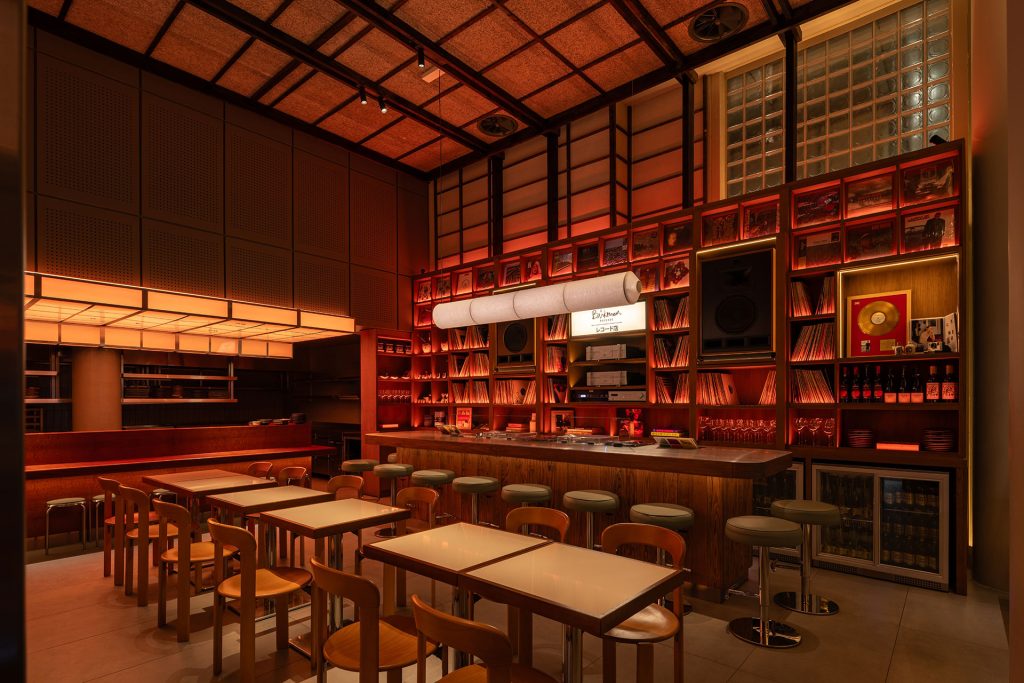
Inside, Flux Office has assembled a palette that operates through honest contrast. Concrete walls, raw and slightly rough, sit alongside natural timber in both dark and pale finishes. Stainless steel surfaces read clean and precise, while ceramic textures provide warmth underfoot and at eye level. Nothing is gratuitously decorative; everything carries a textural argument.
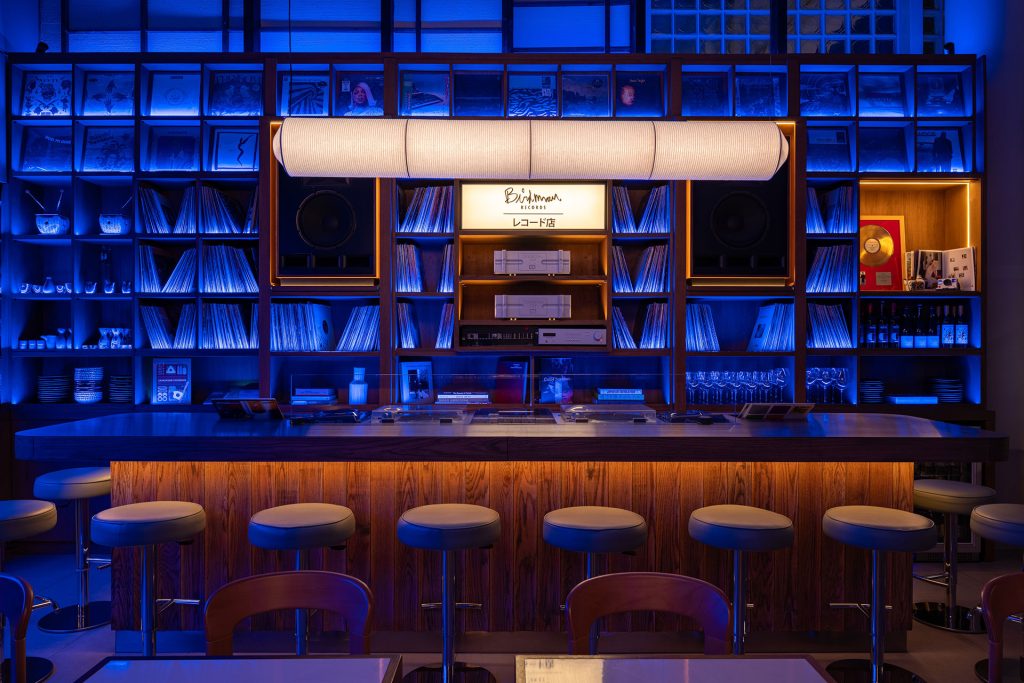
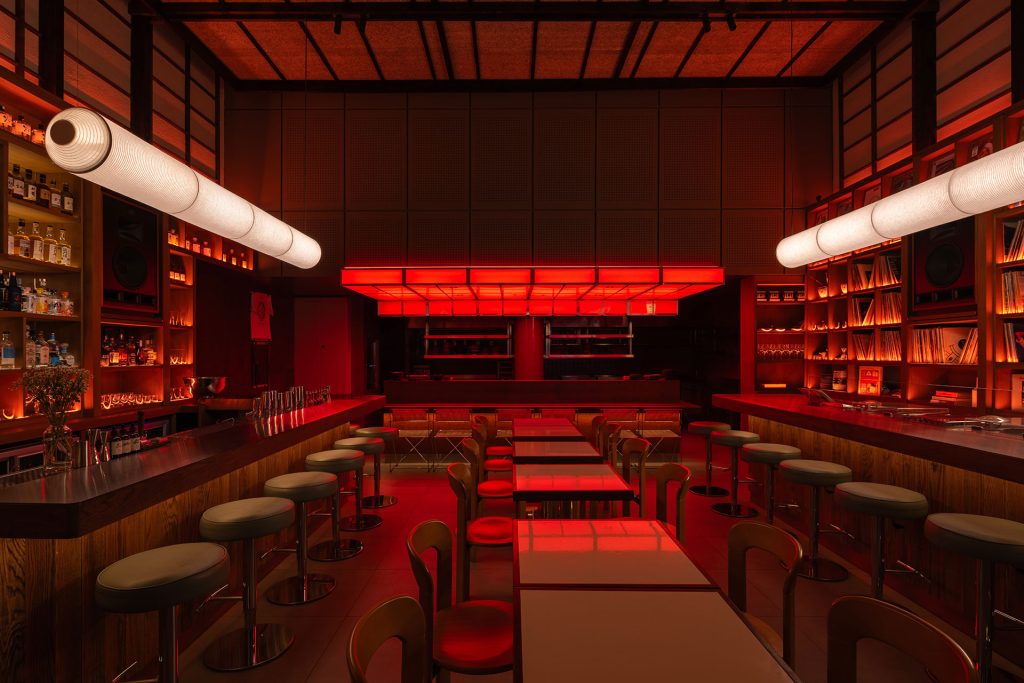
The furniture mixes the canonical with the found. Authentic Rey chairs and X-LINE pieces are placed alongside vintage IKEA Frosta stools, those Alvar Aalto-inflected three-leggers that have spent decades being rediscovered. Custom bar stools upholstered in a quiet sage green complete the picture. The effect is less curated showroom, more knowing edit: a space that has developed taste over time rather than arriving with it fully formed.
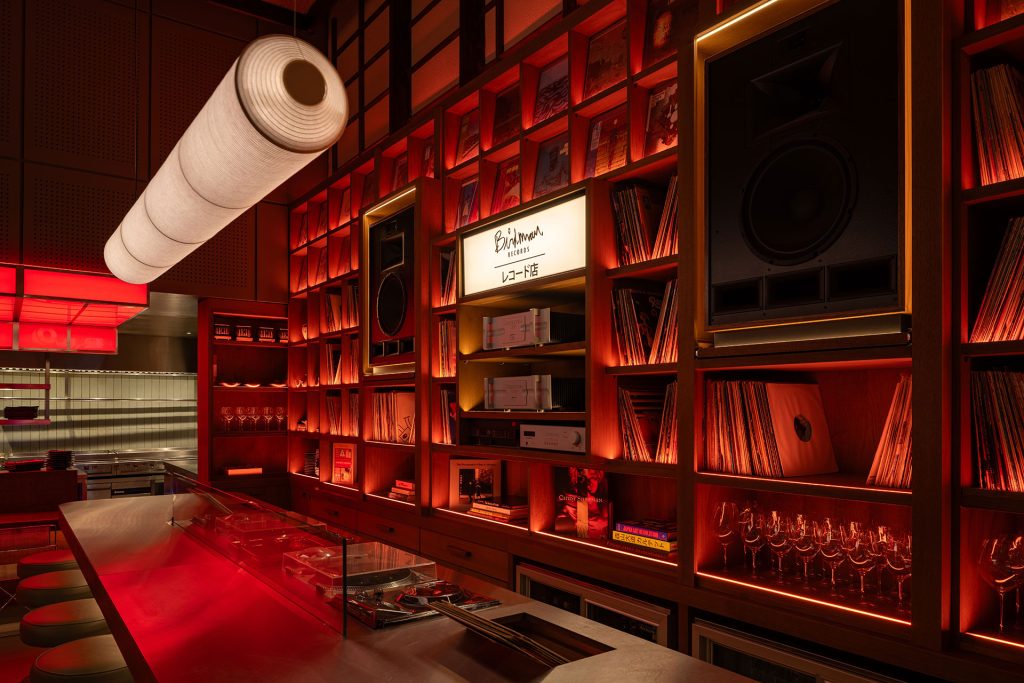
Suspended above the central seating zone, a ceiling element referencing traditional Japanese joinery draws the eye upward and anchors the middle of the floor plate. Below it, the plan is organised around a series of counter-islands: the bar, a DJ console with display shelving directly behind, a pass looking into the open kitchen, and a linear counter that pierces the glass-brick facade itself. That last move positions diners simultaneously inside and out, in a hybrid zone that captures both the energy of the street and the warmth of the room.
“The lower ground and mezzanine levels extend the experience vertically, while a continuous sense of flow between interior and exterior ensures the space never feels contained, only layered.”
The name Ekiben derives from the Japanese words for train station (eki) and meal box (bento): those precisely prepared, region-specific boxes that have accompanied Japanese commuters for well over a century. As both cuisine and ritual, the ekiben represents something that Western dining culture rarely achieves, the elevation of the ordinary into the deeply considered.
That philosophy is exactly what Flux Office has translated into architecture. The space is not grand, not ostentatious. It is 205 square metres designed with the kind of disciplined attentiveness that makes every surface feel chosen and every transition between zones feel intentional. The kitchen is open not as a performative gesture but because concealment would be dishonest, the same logic that drives the cuisine.
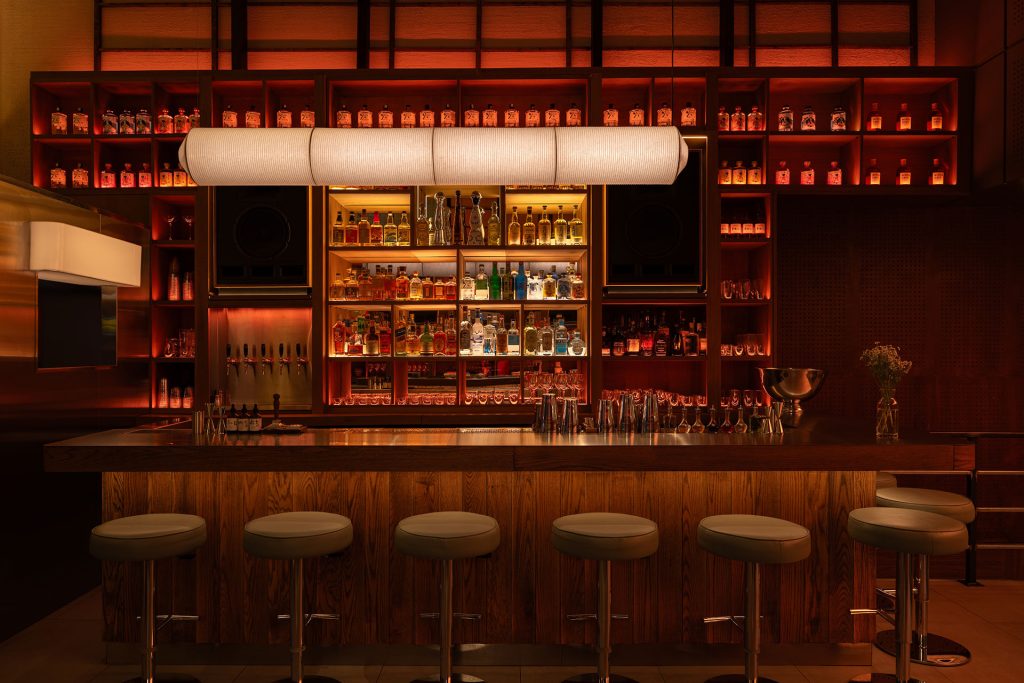
Light design by Evina Diamantara of 18 Fifty ensures the space reads differently hour by hour: bright and focused at lunch, intimate and amber-washed after dark. Structural engineering by Manolis Manios and mechanical systems by Andreas Psaroudakis of CONAP complete a project where every discipline appears to have been fully briefed on the central idea.
Athens is having a moment. Everyone says so, and the restaurants are part of the proof. But Ekiben South is less a symptom of that moment than a model for what sustained creative ambition looks like when architecture, hospitality and cuisine are held to the same standard. Glyfada did not know it needed a Japanese lantern on its corner. It does now.
Location: Laodikis 41, Glyfada, Athens, Greece